Friday, 21 January 2011

Research on Psycho-Thriller


These are the definitions according to Wikipedia:


  • Psychological – Elements that are related to the mind or processes of the mind; they are mental rather than physical in nature. Sometimes the suspense comes from within one solitary character where characters must resolve conflicts with their own minds. Usually, this conflict is an effort to understand something that has happened to them. These conflicts are made more vivid with physical expressions of the conflict in the means of either physical manifestations, or physical torsions of the characters at play.


  • Thriller – Generally, thrillers focus on plot over character, and thus emphasize intense, physical action over the character's psyche. Psychological thrillers tend to reverse this formula to a certain degree, emphasizing the characters just as much, if not more so, than the plot.


  • Psychological thriller – Characters are no longer reliant on physical strength to overcome their brutish enemies (which is often the case in typical action-thrillers), but rather are reliant on their mental resources, whether it be by battling wits with a formidable opponent or by battling for equilibrium in the character's own mind. The suspense created by psychological thrillers often comes from two or more characters preying upon one another's minds, either by playing deceptive games with the other or by merely trying to demolish the other's mental state.


  • Psychological Thrillers are much more intense and deep which makes them more serious. This could actually contradict the fact that people want an element of humour according to our questionnaire results; however it is clear that psychological thriller is the preferred sub-genre. Personally, our favourite is psycho-thriller so we have more knowledge of it.

    Psychological Thrillers are very much focussed on the characters and their minds. They often just focus on one or two characters as to comply with the psychological element the audience must have an incite into the main character's mind. The plot has less focus, unlike average Thriller films.

    Themes of a psycho-thriller:


  • Reality – This is where psycho-thrillers can become confusing -  the characters usually have uncertainty on what is real and what is not - characters are taken out of their normality and the comfort of their minds. The audience experiences this with them.


  • Perception – As we focus on main characters, particularly if it is in first person narrative, we see their perception of the world. This links to the idea of an unreliable narrator. How does the audience know they can trust the narrator


  • Mind – The human consciousness; the location for personality, thought, reason, memory, intelligence and emotion. The mind is often used as a location for narrative conflict, where characters battle their own minds to reach a new level of understanding or perception.


  • Existence/ Purpose - The object for which something exists; an aim or a goal humans strive towards to understand their reason for existence. Characters often try to discover what their purpose is in their lives and the narrative's conflict often is a way for the characters to discover this purpose.


  • Identity - The definition of one's self. Characters often are confused about or doubt who they are and try to discover their true identity.


  • Death - The cessation of life. Characters either fear or have a fascination with death.


    Literary devices and techniques

    • Stream of consciousness - a literary technique which seeks to describe an individual's point of view by giving the written equivalent of the character's thought processes. In psychological thrillers, the narrative tries to manifest the character's psyche through word usage, descriptions, or visuals.
    • First-person narrative - a literary technique in which the story is narrated by one or more of the characters, who explicitly refers to him or herself in the first person, that is, "I". This direct involvement that the characters have with the story in turn makes the reader more involved with the characters themselves, and thus able to understand the mechanics of the characters' minds. This technique is often paired with the concept of the unreliable narrator.
    • Back-story - the history behind the situation extant at the start of the main story. This deepens the psychological aspect of the story since the reader is able to more fully understand the character; more specifically, what the character's motivations are and how his past has shaped his current cognitive perceptions.

    Tuesday, 18 January 2011

    Questionnaire


    Audience Research:

    The typical age of the audience who we're aiming our film opening at is roughly14-18. Our film plot would most likely fit an age 15 category, therefore the most likely people to watch it would be this age. This means there are certain factors like language and violence which we need to consider that would be appropriate and not offensive for our audience. This age range is similar to our own age, we can benefit from as we will personally be able to understand what they think makes a good thriller film.
                Our questionnaire will be completed by local people from the area who will all share similar backgrounds and possibly similar incomes. Because of this, we have a good idea of what makes a believable plot and setting for our film. With people earning similar incomes means that their interests will be generally similar, for our case locals from Whittlesey area aren't over critical, more-than-average-wage earners giving us an idea of the quality that the filming of our film requires.
                Linking this is the possible location for our film; it will be local therefore realistic for our audience. The more realistic and familiar the setting is, the more believable the overall plot will feel to our audience. Whittlesey is a rural town which will probably reflect in our film, taking in to consideration that there are limited places we could film it is likely that we will involve some rural aspects. To keep our plot realistic and connected to our audience we will keep the plot to our time period, this will stop anyone from being confused too.
                The demographics for our film opening isn't specific, it needs to be appreciated equally by both genders


    Question 1.  Are you:       Male       Female

    Result:

    We intentionally asked 10 females and 10 males to ensure we get a fair result. Opinions and preferences can be determined by the gender of the person because of the different ways in which males and females are treated; males are brought up to be very masculine and females are brought up to be very feminine. Men tend to have bravado; they have to appear brave for the approval of people. Females tend to be more vulnerable and sometimes like to appear slightly weaker than males. These aspects influence opinions.

    Question 2. What age range do you fit into?
    As previously stated, everyone we asked was between the age of 14 and 18. Our film will be aimed at this age range so we thought it would be best to receive our audience research from the relevant people.

    Question 3: What do you think makes a good film?

    Peoples opinions:
    Ÿ         Strong story
    Ÿ         Good actors
    Ÿ         Believable
    Ÿ         Good directing
    Ÿ         Must look high-quality even if it's low budget
    Ÿ         Action
    Ÿ         Element of humour
    Ÿ         Violence
    Ÿ         Good vs. bad
    Ÿ         Epic parts
    Ÿ         Horror
    Ÿ         Unpredictability
    Ÿ         Good acting
    Ÿ         Realism
    Ÿ         Imaginative
    Ÿ         Interesting
    Ÿ         Engaging
    Ÿ         Follows conventions of the genre
    Ÿ         Something which captivates the audience
    Ÿ         Suspense
    Ÿ         Questions to be answered

    This gives us a lot of elements to consider with our film:

    Ÿ         We must have a strong plot and this must show in our opening, the opening initially captivates the audience and depicts whether they keep watching or not. The point of the film is to tell the story, if there is not a good plot, the film will not meet it's purpose. Every media text is created with an intention. The thriller genre is a broad genre which allows us to be imaginative (which has proven to be another important feature) therefore we can make a strong storyline.
    Ÿ         The actors play a big part in attracting the audience. This is through the two-step flow - people see an actor they like, they then recommend the actor's films to friends or family. However, for our task we obviously cannot use 'good' actors, but we can do our best to improve the acting from out preliminary task. Instead of improvising, we have a volunteer from the performing arts group therefore the acting should be of the best we can access.
    Ÿ         The plot needs to be believable and have a sense of realism. If the plot is too unrealistic it tends to irritate people and it won't keep them interested. It can be imaginative and it is fictional so it doesn't have to be an exact representation of reality, but the interpretation must be believable on some level.
    Ÿ         Good directing is key. As a group we have to be in control of the whole production. We have to direct the actor, manage the setting, manage the costumes and manage the camera work. The piece has to reflect confidence, if a film is not well-directed, it shows.
    It must look high-quality. We must use what we have to the best of our ability. We are incredibly low budget in that we have to improvise with the setting, the actors and the costumes. We also have to make do with amateur lighting and camera work, but it is possible, with editing, to make the film look higher quality than it is. This will require rehearsing before filming and practising of the camera shots

    Question 4: What is your favourite thriller?

      
    This chart shows the most favoured films of 20 people aged 14-18. There a 4 obvious favourites, 'The Strangers', 'District 9', 'Panic Room' and 'Saw'. We can now use this information and investigate these films to find out the elements that make our intended audience like these films. The information obtained isn't as useful as hoped as the largest number of people that like a film is only 3, which is 15% however it will give us a better idea than we had before.

    Question 5: Why is this your favourite thriller?
    The most occurring answer for this question was that the film held the viewer in suspense. This made us consider that if we wanted to make a successful thriller opening, we would need to add suspense for it to appeal to a majority of the audience.
    Other elements people considered to make a good thriller film:


    Question 6: What do you think is needed to fulfil the criteria of the thriller genre?

    For this question many of the respondents answered with suspense and tension. Again, this made us realise that to make a good thriller we must add these components for it to appeal to a wide audience.
    Other  factors considered by respondents:
    • Character point of view
    • Shocking moments
    • Realism
    • Unexpected scenes
    • Scared victim
    • A twist in the plot
    • Action
    • Death or separation
    • Scary scenes
    Question 7: Do you prefer a realistic plot or a more imaginative plot?

    75% of the respondents answered that they preferred a realistic plot over a imaginative one. By them saying this, we decided it was best to base our opening around a realistic story line so it appealed to a wider demographic.

    Question 8: What is your preferred sub-genre of the thriller genre?


     10% of respondents enjoyed the crime thriller sub-genre, 15% enjoyed mystery thriller and the remaining 75% preferred psychological thrillers to the other sub-genres. As psychological is the most significantly popular sub-genre, we decided it would make sense for us to base our opening around a psychological thriller.

    
    Question 9: What perspective would you prefer a Thriller film to from?


     Over half of the respondents would prefer the film to be from the victim’s perspective along with the extra 5% saying they’d watch any. It is then followed by 25% preferring it from the villain’s; there is a wide difference between the two answers therefore we can confirm that the majority of our demographic would like our film more if it was from a victim’s perspective. This is helpful for us to know as it will make our film more popular and therefore successful.

    Question 10: What sort of atmosphere do you think needs to be created in a Thriller?

    There were numerous answers to this question though they all related to each other. The most common answers were suspense, tense and dark, typical features of a Thriller genre. Other answers included:
    ·        Isolated
    ·        Shocking
    ·        Inquisitive
    ·        Scary
    ·        Panic
    ·        On edge
    ·        Uncertainty

    These are all similar answers and therefore give us a clear indication to what our audience consider important to make a Thriller atmosphere. We can now apply our results and consider possible ways to produce the appropriate atmosphere, including the film plot, sound and lighting effects.

    Question 11: What do you think would be a good location for a Thriller?

    Bearing in mind we have limited access to an appropriate location some of the answers won’t be possible.
    The results varied somewhat however there were some which were repeated quite often.


    It is clear that there are three dominant answers, an old house, an abandoned place/building or a forest. In a way these three can be linked given that an old house could be an abandoned building and a forest could be an abandoned place too. These locations are also suitable for us to consider as they are all accessible to us.

    Conclusion:

    Now that we’ve gathered the results and studied each of the question’s responses I feel that we are able to produce a film appropriate for our demographic. The use of the questionnaires has allowed us to see what certain media conventions should be used to make a ‘Thriller’ film.  We are now aware of what our audience favour and expect from a thriller film, therefore we can make a successful opening. There are media elements we are now aware of that should be used to make a ‘Thriller’ film.

    Tuesday, 23 November 2010

    Deconstruction of Existing Films.


    Thriller Films: Alien and Alien: Resurrection

    Alien is a well known thriller sequel, with four films making it a quadrility. To have made three more films after the original could suggest that it successful thriller film. The thriller sub-genre is closely linked to horror, which is noticeable in the Alien films as the audience are provoked to feel disgusted, fear and horrified. The first Alien film was made in 1979 (20th Century Fox) , followed by the second in 1986, the third in 1992 and the last one in 1997. There's almost twenty years difference between the first and last film and there's a noticeable difference of the quality in the opening titles. Just from a glance at the screen shots you can see a difference of colours, the vivid more detailed example of the fourth film compared to the simple first one; the final one is far more disgusting and fear provoking, this is something to think about, whether it's necessary for our thriller film considering our demographics.
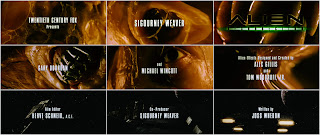

    Both opening titles include the names of the actors and producers as well as the main Alien title. The first film opening spreads the title over the nine clips, gradually building the word 'Alien' by breaking up each individual letter. This delay and gradual build up adds tension before the film has even started, without the use of gory pictures like the final film opening. The first film sticks to a basic slimy green background, not a very attractive colour which might indicate that the film might not be very attractive to watch. Another possible reason for the green background is that many people naturally associate the colour with aliens, therefore setting the general theme of the film.
    The final film opening clearly shows how special effects had progressed since the first film. In the first six opening clips it boasts to the audience how gory and gross the film will be, using close-up shots of the peculiar, disturbing creature. In a way this isn't really necessary as the first film manages to create a tense opening without the gore, however as this is the final film it might have been appropriate to make the film more 'thrilling' to make it stand out from the previous films. Bearing this in mind, for our film we won't have the same equipment, time and resources to create something like the fourth film yet it is still possible to create the same tense feeling as shown by the first Alien film.
    The main title appears on the third clip, which again makes use of the modern effects with the green halo. Again the colour green is possibly used for the general link people make with it to aliens. The following three clips then have stars and a space ship, similar to the first film and therefore linking them to each other, clearly setting it in space. This introduces the audience to where the characters are and their surroundings, however not sharing the thriller and horror themes of the previous clips but being more sci-fi by including a space ship.
    Both film openings use non-diagetic sound of music playing over the top of the titles. They both use orchestra instruments which builds tension effectively, this could be something we could take and use in our main task. The main instruments used were strings, slowly getting louder as the opening progressed. We could either borrow music already made, with their permission, or find someone who could record playing a string instrument.

    Thriller Film: Fight Club

    Fight Club contact sheet

    Fight Club, 1999 is a completely different example of a thriller film. It includes different sub-genres like drama and mystery resulting in what could be a completely different genre to the Alien films. Fight Club is renowned for it's huge budget, something we don't have access to. The opening sequence demonstrates the technical advantages of having a large budget; the clips are either totally produced through a computer or have been altered and enhanced by a computer.
    The opening sequence starts off inside the main character's head, following a glowing impulse through the different nerves in the brain until we eventually move to the outside of the character's head showing a bead of sweat. During this time the credits appear, each name appearing quickly and then given the effect of dissolving. At the same time restless non-diagetic music is played, making the audience tense ad nervous. The camera then continues to follow the characters head, along the top of a gun until it's from a point of view perspective of the person holding the gun. You get an extreme close up of the characters eyes, which are wide open and bruised showing his emotion of fear. Followed by head shots and a mid-shots the audience are able to see the roughness of the character's appearance, by their dirty clothing and poor physical state, and that they're tied to a chair with a gun in their mouth.
    I found this to be an effective way to open the film, along with the title of the film, it introduces the audience to the thrilling and tense themes of the film, as well as letting you see inside the main characters head; the whole film being based around the mental state of the character.

    The beginning is complex and grabs the interest of the audience from the very start. The credits show the most popular actors first, starting with Brad Pitt. This appeals to the audience therefore making them excited, which is also provoked by the jerky, modern music.
    Although we won't be able to use the same computerised effects that this film opening has we can carry different thriller factors like the use of dirty clothing and the idea of being tied up in a chair. This also gives us an example of non-diagetic sound which is able to provoke the audience effectively to .fit the theme of the film. This film is possibly aimed at a slightly older audience than ours is, therefore we need to bear this in mind and not make our film too mature.


    Other Genres: Juno

    Juno contact sheet

    
    Juno is a comedy-drama film based mainly on teenagers but also marriage and responsibilities. The opening sequence is light-hearted and jolly especially in comparison to the thriller Alien films. The animation adds a less mature approach, possibly introducing the audience to the character's behaviour; it's also very different from the majority of film openings which is a reflection of the film overall, as well as the character themself. The colour scheme isn't the usual primary, child related colours that people associate with animation and cartoons, it is more of a mixture of duller tones giving it an older, maturer approach which is quite unique.
    The main title appears next to a long shot of the character 'Juno', which lets the audience establish who Juno is and who the film is focused on. This is a clever technique that could transferred to a thriller film and in our main task, bearing in mind that the film is named after the character or something specific. We have many long shots of Juno where we are able to view their casual clothing and overall appearance, including the Sunny D bottle which is seen as quite comical due to it's large size. The audience also view close ups of Juno's facial expression which is cheery and relaxed. This again reflects the character's overall perspective throughout the film.
    It uses both non-diagetic sound and diagetic sound, with the 'county' style music played over the top along with diagetic sound of runners within the setting. The audience are given a animated view of the setting but still continues to use real sound to confirm that the setting is real. As the setting is animated, the producers are able to emphasise different objects which stand out within the film, for examble the guitar is shown next to the actor Michael Cera's name to make an obvious link to his character.
    Overall the opening sequence emphasises the unique factors of the film and character, it combines animated drawings with the main character who is pixalised. As the character isn't animated into the setting the audience don't misjudge the film to be completely animated.

    Other Genres: Mr. Magorium's Wonder Emporium

    
    Mr. Magorium's Wonder Emporium is a family comedy, somewhat an opposite to a thriller however thrillers sometimes involve comedy to lighten the viewing but it would this would be difficult as it risks taking the 'thrill' away. The demographics for this film is children, the use of bright colours and animated drawings instantly encourages children to watch it. The film is clearly appropirate for a child based audience therefore making it very different to a thriller.
    The title of the film doesn't appear until clip four, giving a slight build up of scenes from the plot. Not until you've watched the film do you realise that these clips are animations of different scenes, nor do you realise that the film isn't animated through out. The text that the title and names are written in shows how the theme of the film is quite unusual, there isn't any sustainability and multiple fonts are used with multiple colours. The muliti colours isn't something that we could use in our thriller film as multi colours generally represent cheerful scenearios, although we could use brights colours for example if we decided to have blood we could emphasise red. The opening has many close ups of certain objects like the paper-aeroplane which lets the audience focus and pick up that this is something that might occur again in the film.
    I don't think an animated opening would be suitable for a thriller film as it is important for thriller films to be realistic enough for the audience to believe that the plot is genuine. However it is a good contrast to compare a family based film as we now know certain factors that we will not use.

    Chosen Film Genre

    After narrowing it down to either drama or thriller we decided to base our film on a thriller genre. We didn't pick drama as although it was something we'd be able to produce, most dramas aren't appealing to an audience of my age. However thriller films are widely popular, not just for my age but for older audiences too. It is also linked to a large variety of sub-genres making it a good choice as we are more open to different elements within sub-genres, this will help our film be unique therefore more interesting and successful.
    The conventions of a thriller film vary along with the different sub-genres, however there's certain things which remain similar. For instance they are often based in cities or the suburbs around a city, the main character finds them in a situation which seems impossible to escape from which normally threatens their life. After deciding on the genre for our main task, we started to look at examples of thriller films. We'll make comparisons and decide what we might like to include in our main task.

    Initial Decisions

    In my group I'm working with Sophy and Bethany, we worked together for our preliminary task which was successful. We went through possible film genres for our main task, genres including action and thriller, and then discussed what would be most suitable for us.
    Bethany wrote down all of our ideas on a mind map whilst me and Sophy looked up different types of films genres and what each of them includes. We had to think about settings and actors available so that we can make our film realistic.